

The more your AI gets used, the less you make.

Two kinds of AI product. One pricing problem.

AI-native companies
• A handful of power users cost more than they pay — and nothing in your pricing catches it.
• You scale, and gross margin gets worse instead of better.
• Every new model release forces a choice: upgrade and absorb the higher cost, or fall behind on quality.
• The best models keep getting more expensive to run at quality, and your pricing was set for the cheap ones.
AI Features
• You can't put a defensible price on what the feature is actually worth to the customer.
• The feature drives real usage and cost, but none of it shows up in what you charge.
• Keeping up with new model releases is a permanent maintenance cost, and none of it is priced in.
Four interventions. One pricing system.


Outcome-based pricing design

Margin architecture

Feature and capability monetization

Pricing as defensibility
The 8-week sprint
Before week 1
Most pricing projects run 12–16 weeks because they start with exploration. We start with hypotheses. Before week one, we already know where your pricing likely breaks — built from your public data, our benchmark library, and a pre-call diagnostic.
Week 1
The workshop at the start doesn’t open questions. It closes scope.
Week 8
Week 8 deliverable: a running Agentic Repricer, a subscription layer proposal, and an impact model showing exactly where the numbers came from. Not a deck. A system.
The economics change by industry

AI-enriched SaaS has brought price premiums of up to 3.2x over traditional offerings in mature markets.

Subscription-based models dominate at 41%, while usage-based pricing accounts for 18%.
Among subscription-based models, 63% position AI as a feature. Under usage-based pricing it inverts - 68% position AI as a tool.
Only 32.7% of UK SaaS companies mention AI on their website, and among those that do, just 31% include a pricing page.
Only 36% of experts see AI as a core product - the rest treat it as a nice-to-have add-on. That's exactly why seriously monetized AI stands out.
Gartner predicts over 40% of agentic AI projects will be abandoned by 2027 - killed by unclear value, risk, and rising costs. The failure mode isn't technology. It's monetization.
Notion turned a single AI capability into a 150% price increase over four years - from $8 to $20 per user - with ARR climbing toward $50M.
AI adoption in DACH SaaS jumped from 24.5% to 32% in a year - which still leaves 68% of products without a single AI feature. The window to differentiate on AI alone is open, but closing.
Companies that package AI correctly lift prices by 30-40% - an uplift that goes far beyond inflation indexation. The condition: customers must see tangible value.
Pricing changes that show up in revenue
We had plans and deals, but pricing didn't reflect our value. A price increase was necessary, and Valueships provided a clear strategy. Adding a custom element kept Sportmonks attractive. The collaboration was direct, with no unnecessary meetings.


Valueships brought the outside-in perspective we needed. With their sharp understanding of pricing strategy and strong diagnostics around our revenue engine, they gave us a clear view of where we stood and what was possible. We paired that with our own knowledge of the product, our customers, and where we’re heading. The result was a pricing strategy that works from all angles - financially, customer-wise, and in sync with our long-term product direction. It was a real collaboration, and the outcome reflects that.


We worked with the Valueships team on our pricing and they were the most thorough, professional, precise, scientific and strategic company we have worked with. Loved the team and what we together came up with. We’re slowly implementing our pricing model now for Salesmsg based on the new model they made for us.


Working with Valueships was incredibly valuable. They’re one of the few agencies that truly deliver -with deep SaaS expertise and measurable results. Together, we redesigned our entire pricing structure and launched a new pricing page, which delivered a conversion uplift of over 12%, empirically confirmed through a split test. I can highly recommend Valueships to any SaaS founder who wants to unlock the full potential of pricing.


The Valueships team did an excellent job carving out an entire pricing strategy, shifting our business model into new territories. They facilitated the discussion and pushed us in the right direction. They also supported their reasoning with fact-based analyses and data-driven arguments.


The business impact of the pricing changes and ROI of the project was so high we even had to communicate it to our investors. It was the first time we have approached the pricing model thoroughly: with data and research. We wouldn’t be able to do it without Valueships.


Our cooperation was super smooth. Everybody was very involved and excited on both sides, and we quickly built a great relationship. It felt almost as if they were a part of our team, new folks trying to prove their worth. Their recommendations were eye-opening even for a team that went through the process probably 15+ times in the past.


We're operating in a highly competitive sector of analytics software & session replays. Valueships helped us validate our initial pricing hypotheses and calculated various price increase scenarios. They analyzed our revenue data, showing us which customer segments are growing and changing, and taught us how to interpret it in a pricing context. It allowed us to make a pricing change decision aimed at optimizing our current monetization model.


Valueships supported us on key strategic initiatives over the course of 2 years. Valueships experience in strategy planning and execution as well as scaling the organization was very useful. Team is agile, focused on the results and always takes into consideration the big picture. They are not afraid to stand by their recommendations, which is proven by joint collaboration during implementation. I find our cooperation very helpful.


The Valueships team made a complex process feel smooth and easy. At first, I thought that with products like ours (and such a market), it would be challenging to determine prices using statistical models, but in the end, it turned out that it can be done and works. We got more than expected in terms of financial results.


As CFO, I've observed a notable shift in our approach to growth and business. We've transitioned from a client growth-based strategy to a value-based strategy to reflect the value of our tool for our clients. This approach has instilled a sense of calm in our management team and bolstered our business confidence in a way you cannot underestimate.

Working with Valueships was a pleasure from start to finish. They framed the problem correctly, provided us with a structured approach, calculated the impact of our potential decisions, and facilitated the change management process throughout a few months.


Valueships expertise in SaaS pricing and deep understanding of our challenges were evident from the outset. Their analytical approach, combined with an insightful communication strategy, not only drove our MRR significantly up but also ensured customer retention. The team at Valueships didn’t just provide a solution - they equipped us with tools and insights that will benefit us for years to come.


It was worth organizing a workshop with Valueships and working on our selling model and pricing. We worked through many threads thanks to their pricing and value experts. They know the latest approach to value selling in B2B sales. Valueships helped us refine our ideas for new products and services and connect the dots between many topics such as pricing, sales, value of our services, and general business strategy.


We met with the Valueships team at a workshop to answer the question: how to do good pricing? And after 11 hours, we had the answer! While working with Kris, we defined a straightforward monetization, market entry strategy and developed a value-based pricing framework. Their ready-made frameworks are a significant advantage, providing a clear direction for independent work. The workshop with Valueships is a great start to begin your journey with pricing!


We've hired Valueships to help us with the pricing challenge at Callpage, and we're hiring them for a 2nd time for Certifier. What I like about them is their high responsiveness, agility, and data-driven approach. They're not afraid to make the recommendations, which you may not fully agree on initially, but they support it with facts. They have vast knowledge on SaaS, benchmarks, and best-in-class examples.


Our cooperation isn't based on "we will give you some tasks, and you should do it" but on their initiative. They observe us, and after that, they give us ideas & insights to boost our business growth. We were impressed by their professional approach, dedication and more than happy with outstanding results, so after the project, we decided to hire Valueships team as strategic advisors.


One thing is to increase the prices for existing customers; something different is to transition them to the revenue model. Valueships experts helped us with doing so. Considering the communication with my customer group, it is important that they have also assisted me when it was tough. Ultimately, we received positive ROI from the project.


It was great working with the Valueships team to redefine SOHOshop’s strategic approach and witness our remarkable 25% MRR growth. The collaboration not only improved our revenue - but also re-positioned SOHOshop as a transformative B2B e-commerce platform. I’m really proud of what we’ve achieved together. Valueships’ dedication to innovation makes them a standout partner.


The only place to start working on a pricing strategy is at workshops with the Valueships team. During the workshops, we received specific guidance on our pricing policy, and the knowledge of Kris Szyszkiewicz and Maciej Wilczyński show that price changes don't have to be daunting. Thanks to our collaboration with Valueships and their frameworks, we were able to develop a fully-fledged pricing strategy shortly after the workshops.


Valueships supported Nanavo in a strategy project with a pricing component. The team had a great mix of analytical, consulting, and research skills. Also, expertise in SaaS, Pricing, and Business Models was vital for success. Our collaboration significantly accelerated various strategic initiatives and helped us to execute them properly.


Our collaboration was both smooth and professional. Valueships showcased good project management skills, as they met a very short deadline. They helped us to operationalize yearly strategy. The team was focused on long-term and sustainable results and was very responsive to our feedback. Valueships delivered tailored solutions and brought vast experience in the Software industry. We also found additional insights very helpful; they brought our attention to things we hadn't thought of before.


We chose to attend the workshops with Valueships because we knew that no one could guide us through the "dark forest of pricing changes" as well as they could. During workshops, we received clear and straightforward guidelines for improving our pricing. We understood the mechanisms that help answer the question of how to create a value-based pricing model. Even after the workshops, I know I can return to Kris with any pricing dilemmas, and together, we will find a solution.


I just finished reading the report about the State of Polish SaaS Pricing, and I'm pleasantly surprised. There's a lot of insightful information here. I'll definitely be discussing it with my team.


At Digitree Group, we have numerous products and projects. Valueships helped us restructure the business case and revenue model for Revhunter. The consultants helped us reshape the model and challenged us to think differently about the value we create via our service. They are always prepared for the meetings, provide case studies from various industries, and do as much as possible to identify the best source of truth. Strong recommendation from our side.


Scanning over 300 price lists of Polish SaaS is challenging, and the Valueships & Innovation Nest team coped perfectly. They created a report from which the industry can learn a lot and draw conclusions that can directly translate into improved business profitability. That report is a well-executed presentation and a must-read for anyone dealing with SaaS.


We tried to handle our pricing and analyze competitors' prices on our own, but soon realized we needed an expert. After working with the Valueships team and following their advice, I noticed significant improvements in our business. We achieved a doubling of the company’s growth rate, fewer problematic clients from India, and more high-value clients from the USA, which positively impacted our overall client composition. Additionally, our market perception and credibility improved due to realistic pricing.


Pragmatic approach & statistics. We follow these two principles, and Valueships handles them both exceptionally well. They delivered a robust quantitative and qualitative pricing research input, staffed data analysts on the project, worked thoroughly with our internal data, and even remained flexible and agile enough to re-scope the project to match the changing business context better - one of the best expert teams on the market.


Top experts in SaaS industry helping me build a community for start-up founders. I've hired Valueships to help me with dedicated analyses and reports pushed to our users through marketing channels, e.g., via groups and newsletters. Always responsive, delivering on time with excellent quality. Very much recommended.


The value & price waterfall
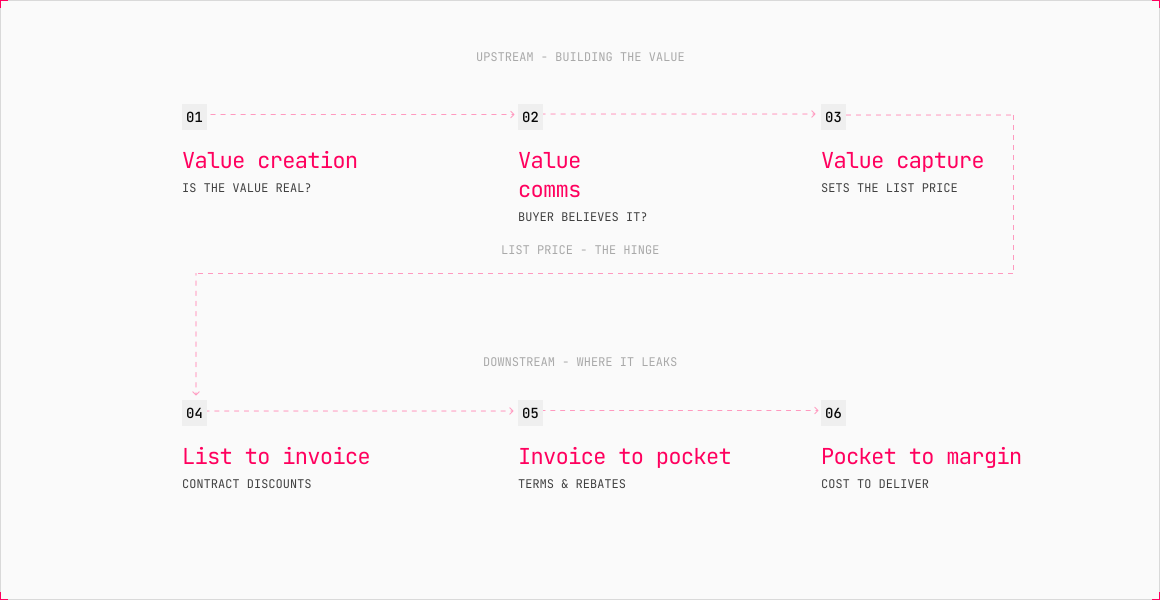
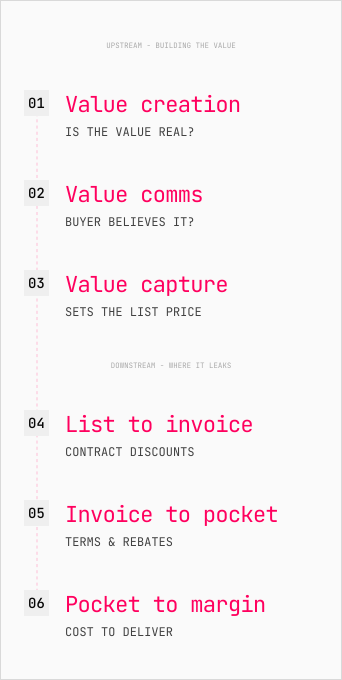
We treat pricing for AI as engineering, not packaging.

An AI product looks more like a telecom operator than a SaaS company. The cost of delivering value moves with usage and with the market. So we build margin into the structure itself - buffers, commitment tiers, credit pooling. Your pricing doesn't need a rewrite every time model costs shift underneath you.

Your customer should pay for what they get, not the model running behind it. We design pricing that holds steady whichever model you use. So you're free to switch to a cheaper or better provider whenever one shows up, and keep the savings, without renegotiating a single contract. The customer sees stable pricing. You keep the margin.

Nobody has settled how to price AI products yet, so we don't guess. We bring the AI SaaS Pricing Canvas and 30+ real models from companies like Cursor, Harvey, and Clay, so you see exactly how the leaders price. AI-native companies get a short head start before real competition arrives. Get pricing right in that window, and it becomes the standard others react to.
A good fit looks like this

B2B SaaS or AI-native company. 40+ headcount (20+ for AI-native). No dedicated Head of Pricing.

A product that delivers measurable economic value - but pricing that doesn't reflect it. AI features live. Packaging designed around engineering constraints, not customer segments.

Founder, CEO, CRO, VP Product who owns the strategic monetization decisions.
If your sales team discounts to close, your AI features went live without a pricing decision, or your customers leave at renewal without knowing what they paid for - this is the right starting point.

Find the value hiding in your business
Both fit here, and the distinction shapes the work. If AI is your core delivery - an agent, copilot, or automated workflow doing the work - you’re AI-native, and the focus is building the model around your cost structure. If AI is a capability inside a broader product, the focus is monetizing that feature without disrupting your existing pricing.
Because in an AI product, serving more usage genuinely costs more - unlike classic SaaS, where the next customer is nearly free. If pricing doesn’t account for that variable cost, scale works against you: your heaviest users become your least profitable accounts. Fixing that structurally is the core of AI product pricing.
No - it makes structure essential. The point isn’t to chase model costs with your pricing; it’s to build pricing that absorbs the volatility, so your price stays stable while your margin stays protected underneath.
Usually it’s the opposite. Pricing set casually at launch becomes the model you’re stuck defending later, and the AI category’s standards are being written right now. If you’re not sure whether it’s the right moment, a quick consultation is the easiest way to find out - getting it right early tends to be an advantage, not a premature optimization.
Typically the founder or CEO on the monetization call, the CTO when cost structure and margin are the concern, and the Head of Product when it’s about packaging what the product does.