
.png)

A leading travel software provider offering a PMS (Property Management System) and OTA (Online Travel Agency) platform. The company serves a significant portfolio of hospitality partners across multiple markets, helping them manage bookings, increase direct reservations, and grow their online presence.
The product is excellent. The client base is loyal. However, optimizing revenue from current customers- through expansion revenue and improved monetization - was critical for unlocking further growth. Implementing key strategies for saas pricing optimization was essential to address this challenge. But the monetization model? It was holding the business back. And that’s exactly where we came in.

“We knew we were leaving money on the table, but we didn’t know how to fix it without risking our customer relationships. The Valueships team gave us a clear framework and the confidence to make a fundamental shift in how we monetize. The results speak louder than anything we could say.”
The client had hit a growth ceiling. Despite delivering real, measurable value to their partners - more bookings, better visibility, higher occupancy - their flat-fee subscription model couldn’t capture any of that upside.
Here’s the core problem: the pricing had nothing to do with the value being created.
High-volume partners who were generating significant revenue through the platform were paying the same as everyone else. Meanwhile, smaller partners faced high entry barriers because the flat fee felt steep relative to their usage. It was a lose-lose.
On top of that, expansion revenue was virtually nonexistent. Expansion revenue is any revenue generated in excess of a customer's initial purchasing price or contract, typically measured as expansion MRR (monthly recurring revenue from existing customers). This is more financially efficient than acquiring new customers, as upselling and cross-selling are the primary drivers of expansion revenue. By growing expansion revenue, companies can generate more money from their current customers, reduce churn, and improve other metrics such as net MRR churn, customer lifetime value (LTV), and payback period.
The fixed model offered no natural “upsell” path beyond basic seat or module additions. The company considered a standard price hike, but quickly realized it would be too risky — difficult to justify without a clear value-link and almost guaranteed to increase churn. Increasing prices without tying them to added value can drive customers away, whereas focusing on expansion revenue through value-based or usage-based pricing helps reduce churn and leads to better financial outcomes.
Something fundamental had to change. Not just the prices, but the entire monetization logic.
The objective was bold but clear: transition from a fixed-access subscription model to a new pricing model - a usage based model - that scales with customer success. This approach is increasingly common in B2B SaaS, with three out of five companies now using some form of usage-based pricing.
In practice, this meant building a pricing structure where revenue grows as partners grow - without triggering churn during the transition. Usage-based pricing allows small businesses and more customers to start using the product at a comparatively low cost and scale up as they grow, making it flexible for both small and large organizations. The client also wanted to unlock entirely new revenue streams through add-ons and premium features, something the old model simply couldn’t support. Usage-based pricing is intrinsically tied to customer success, as revenue growth depends on customers using and seeing value from the product, which can lead to higher customer lifetime value as customers expand their usage over time.
This wasn’t a simple price increase. It was a full monetization transformation. We applied our proven framework across three phases to ensure the new model was not only strategically sound, but also financially validated and operationally ready. Having the right tech stack - including tools for metering, billing, and automation - was essential to support usage-based and hybrid pricing models throughout this process.
We started where we always start - with the data. We conducted a deep dive into the client’s usage telemetry, P&L, and customer lifecycle to understand how value was actually being created and consumed. Value-based pricing centers on setting product prices primarily on the value that customers assign to the product or service, which requires determining perceived value and willingness to pay.
Key activities included:
To set prices effectively, companies must spend significant time understanding customer needs and gathering feedback. Open communication channels and strong customer relationships are essential for obtaining feedback on desired features and how much customers are willing to pay.
Value-based pricing is different from cost-plus pricing, as it focuses on perceived value and is especially effective for companies with unique or high-value features. This approach is resource-intensive because it requires gathering and analyzing customer data, but it allows companies to set prices at the highest level customers are willing to pay and can promote customer and brand loyalty. ROI calculators and similar sales tools can help demonstrate value and justify premium pricing tiers.
This phase confirmed what we suspected: the flat-fee model was massively undercharging high-value users while creating unnecessary friction for smaller ones. The value metric was clear - it had to be transaction-based.
With the diagnostic behind us, we moved into designing and validating the new monetization architecture. We assessed three distinct pricing archetypes before landing on the optimal solution. As part of this process, we tested different tiers and different features in various pricing packages to identify which configurations drive the most value and revenue. Testing different price points and plan packages also enabled us to drive up-sells and cross-sells, ensuring the pricing structure met diverse customer needs. Feature-based pricing, where customers pay based on the features they use in a SaaS product, was also considered as a strategy to maximize monetization.
The Selected Model: Commission + Credits Hybrid
But we didn’t stop at the design. We stress-tested it rigorously:
The numbers gave us - and the client - the confidence to move forward.
A model this different required an equally thoughtful rollout strategy. We identified 12 distinct customer segments and tailored the migration approach for each one.
Segmenting customers for a smooth transition
To make the transition as efficient as possible, we didn't just divide customers into random buckets. We built a segmentation model based on two critical dimensions:
X-axis: How does the new pricing affect the accommodation provider's income? We calculated the percentage change in each partner's net income (GMV minus the platform's take rate) under the new model compared to the old one. Some partners would see their income decrease slightly (left side of the chart), while many would actually earn more (right side) - in some cases significantly more.
Y-axis: How likely is each customer to switch to the new model? Based on internal preference data and behavioral signals, we scored every customer's propensity to migrate on a scale from 0 to 10.
This gave us a clear 2x3 matrix with six distinct segments:
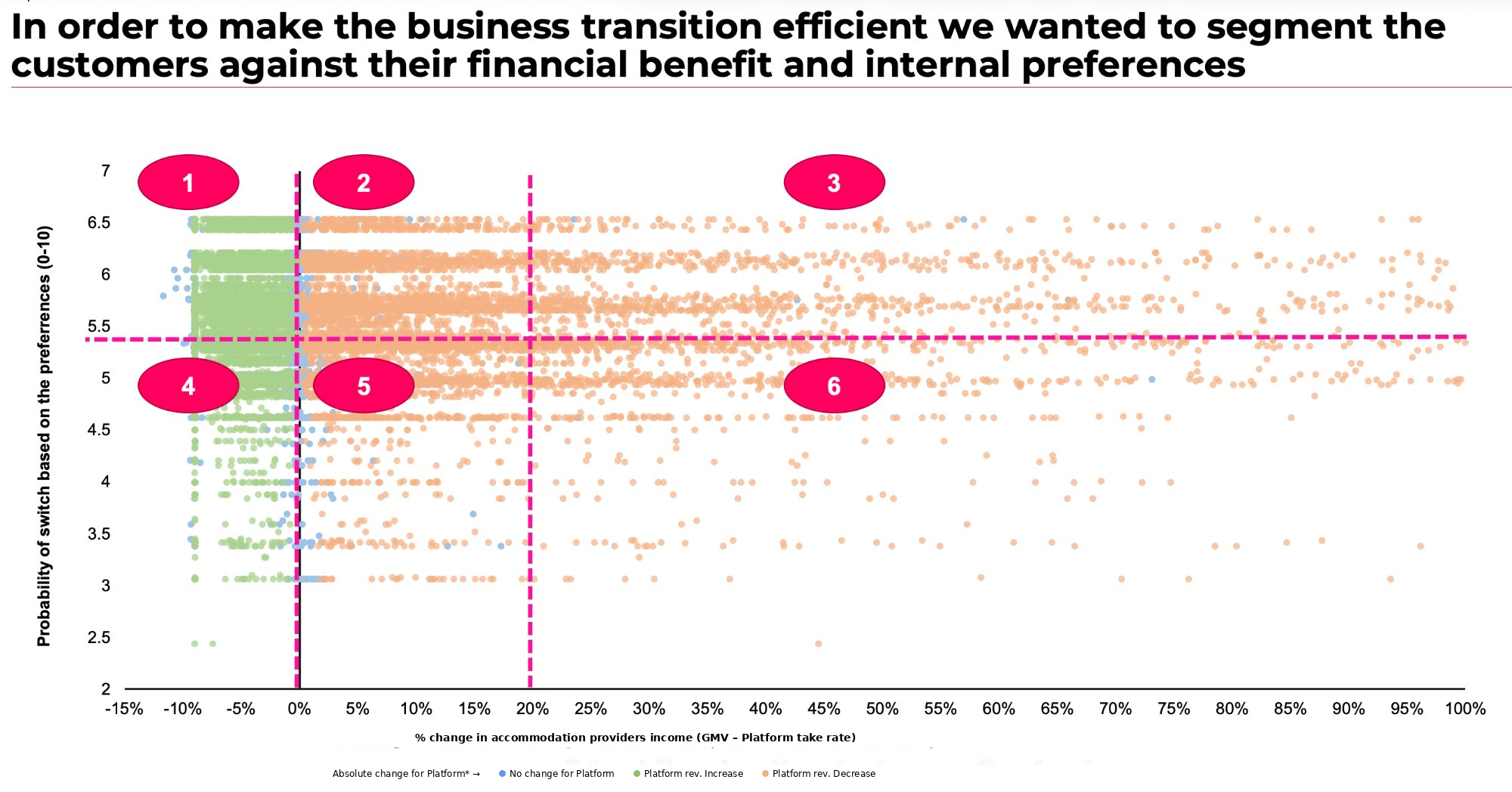
The color coding tells an equally important story. Green dots represent scenarios where the platform's revenue increases, while orange dots indicate a decrease. The key insight? The vast majority of the customer base sits in territory where the new model creates a win-win - partners earn more, and the platform captures value proportionally. Only a small cluster in the top-left represents a potential friction point, and that's precisely where we focused our communication toolkit.
This kind of data-driven segmentation is what separates a risky price migration from a controlled, confident rollout.
The rollout followed a "semi-aggressive" strategy:
Phase 1 (Months 1–3): New sign-ups only. All new customers were onboarded under the new model from day one. This served as a live market test of acceptance and allowed us to fine-tune messaging before approaching the legacy base.
Phase 2 (Months 4–6): Incentivized migration for existing customers. We designed "early-bird" credit bundles and feature access perks to encourage legacy customers to migrate voluntarily. Each segment received tailored communication — different messaging, different value arguments, different timing.
To support the transition, we delivered:
With roughly 80% of the implementation complete, the impact is already substantial - and growing.
The new pricing model is also expected to result in higher customer lifetime value, as usage-based and expansion revenue encourage ongoing engagement and upgrades. Higher subscription payments and additional services purchased by existing customers mean more money and directly increase LTV. This approach also improves other metrics such as net MRR churn and payback period, further strengthening overall SaaS business performance.
But perhaps the most important result isn’t a number. The client successfully shifted from a “vendor” mindset to a “partner” mindset. Their pricing now scales automatically as their customers grow. That’s not just better monetization - it’s a fundamentally better business.
And the implementation isn’t even finished yet. We expect the full impact to be even more substantial once the remaining 20% of the rollout is complete.
Look, we've been in enough boardrooms to know that even the sharpest SaaS teams can stumble into pricing traps that absolutely kill their revenue potential. And honestly? The most common mistake we see is skipping the hard work of proper market research and customer feedback. Companies just... guess at price points and throw together pricing tiers without really understanding what their customers actually value. The result? You're either leaving serious money on the table or watching customers walk away faster than you can count them.
But here's where it gets painful - and we can't sugarcoat this because we've seen it too many times. Teams set their pricing once and then just... forget about it. They stick with outdated strategies while market conditions shift, customer needs evolve, and competitors make moves around them. Meanwhile, their profit margins get squeezed and they wonder why new customer acquisition feels impossible. Add in murky, confusing pricing communication (because transparency is apparently optional?), and you've got a recipe for customer confusion, broken trust, and churn rates that keep executives awake at night.
The fix isn't rocket science, but it does require commitment. Stay connected to your customers - actually talk to them, seek out their feedback, and keep an eye on what your competitors are doing. Use your data and analytics to make smart adjustments instead of flying blind. When you take a flexible, evidence-based approach to pricing, you're not just optimizing revenue - you're building real customer satisfaction that drives sustainable growth. And in our experience, that's where the magic happens.

+12% revenue growth from usage-based pricing

+10% expansion revenue from Credits ecosystem

+9% total corporate revenue uplift

12 distinct customer segments with tailored migration Commission + Credits

new hybrid monetization model

80% implementation complete - full impact still growing

Certified expert in price, revenue and margin management in B2B companies and e-commerce. Member of the prestigious Professional Pricing Society. At Valueships, he is responsible for the implementation of consulting projects and taking care of the profitability of clients. Prior to joining Valueships, he worked at McKinsey & Company in the area of pricing and strategy.
Schedlue a free consultation
Certified expert in price, revenue and margin management in B2B companies and e-commerce. Member of the prestigious Professional Pricing Society. At Valueships, he is responsible for the implementation of consulting projects and taking care of the profitability of clients. Prior to joining Valueships, he worked at McKinsey & Company in the area of pricing and strategy.


